Effective Modern Python 2018
Contents
- Type Annotation
- Data Classes
- Packaging and Dependency Management
Type Annotation 
Some benefits of type annotations
- Static code analysis prior to runtime
- PyCharm (IntelliJ)
- mypy
- Self-documenting
- Code itself is a document
- Code completion
Chainer RNNLM Example
train, val, test = chainer.datasets.get_ptb_words()
- Type of
train,val,test? - What kind of operations can be done on these variables?
🤔
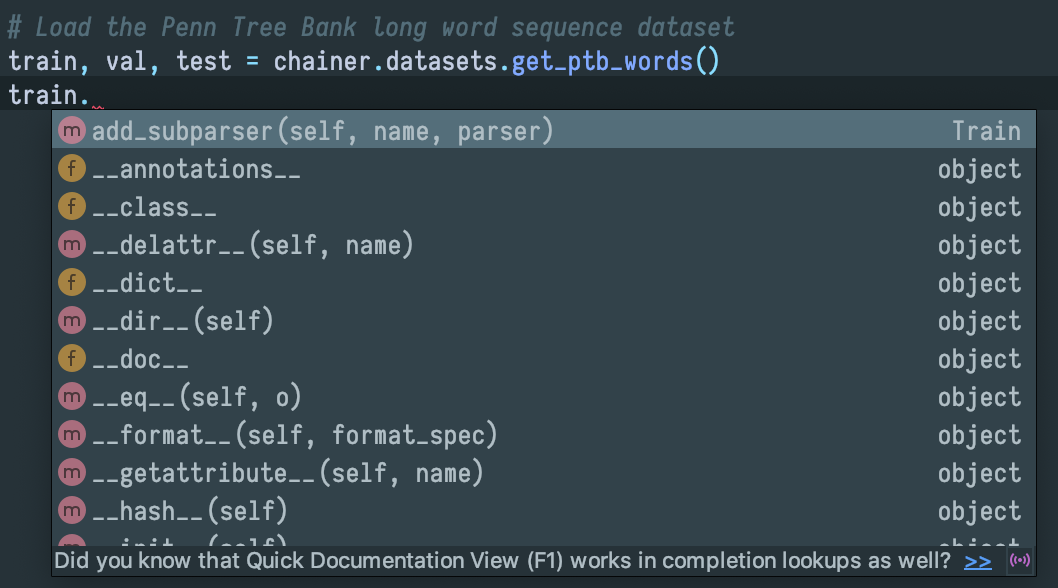
Go to Declaration
def get_ptb_words():
    """Gets the Penn Tree Bank dataset as long word sequences.

    [...]

    Returns:
        tuple of numpy.ndarray: Int32 vectors of word IDs.
    """
    train = _retrieve_ptb_words('train.npz', _train_url)
    valid = _retrieve_ptb_words('valid.npz', _valid_url)
    test = _retrieve_ptb_words('test.npz', _test_url)
    return train, valid, test
- 😸 docstring
- 😿 IDEs can’t parse complicated types
Add Type Annotations
from typing import Dict
def load_vocab(vocabfile: str) -> Dict[int, str]:
    [...]
# typed!
vocab = load_vocab(vocabfile)
If you can’t modify function declaration…
# function of other libraries
def load_vocab(vocabfile):
    [...]
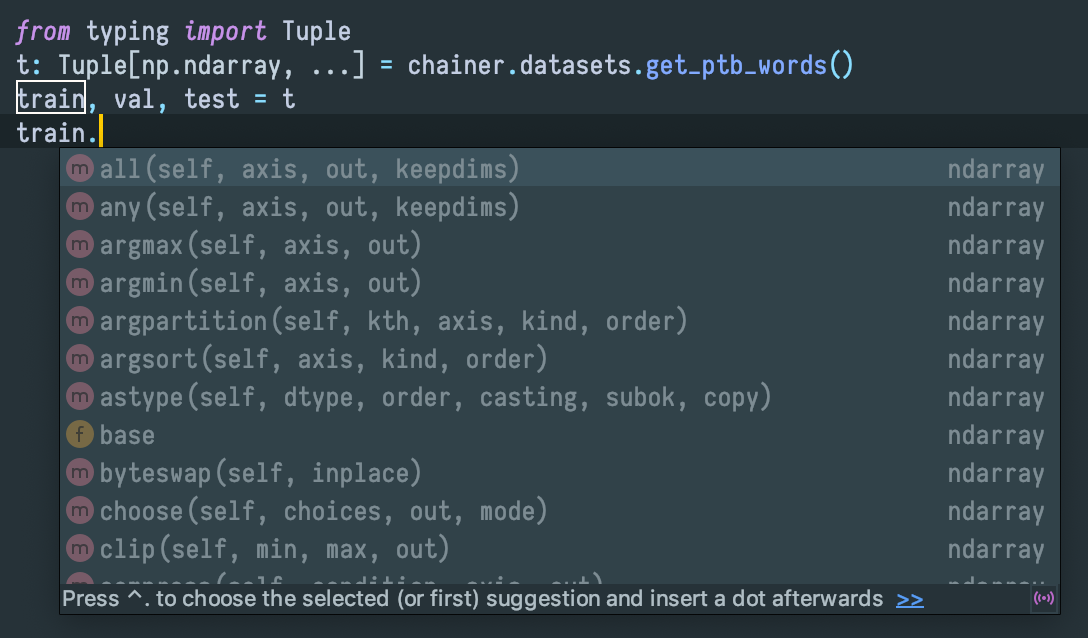
from typing import Dict
# typed!
vocab: Dict[int, str] = load_vocab(vocabfile)
🤗
Data Classes 
Easier Way to Write Classes 🤗
from dataclasses import dataclass
from typing import Dict, Optional

@dataclass
class Vocabulary:
    padding_token: str
    oov_token: str
    max_vocab_size: int
    pretrained_files: Optional[Dict[str, str]] = None
- Similar to Scala’s Case Classes
Conventional Class 🤔
class Vocabulary:
    def __init__(
        self,
        padding_token: str,
        oov_token: str,
        max_vocab_size: int,
        pretrained_files: Optional[Dict[str, str]] = None,
    ):
        self.padding_token = padding_token
        self.oov_token = oov_token
        self.max_vocab_size = max_vocab_size
        self.pretrained_files = pretrained_files

    def __eq__(self, other):
        if isinstance(self, other.__class__):
            return self.__dict__ == other.__dict__
        return False
- Documentation (en / ja)
- attrs library is also recommended
- more features than Data Classes
- move faster
Packaging and Dependency Management
- How to reproduce your environment?
- How to make your program
pipinstallable?
Other languages have great tools
- Scala:
sbt - JavaScript:
npm,yarn - Rust:
cargo - Go:
dep - Python: …🤔
Ancienty Way 🤔
- Dump all installed packages and force to download them all:
$ pip freeze > requirements.txt
$ pip install -r requirements.txt
- Need to manage virtual environment at your own responsibility
- Don’t you have unnecessary dependency?
- How is version compatibility of Python and libraries?
- Metadata management?
Medieval Way 🤔
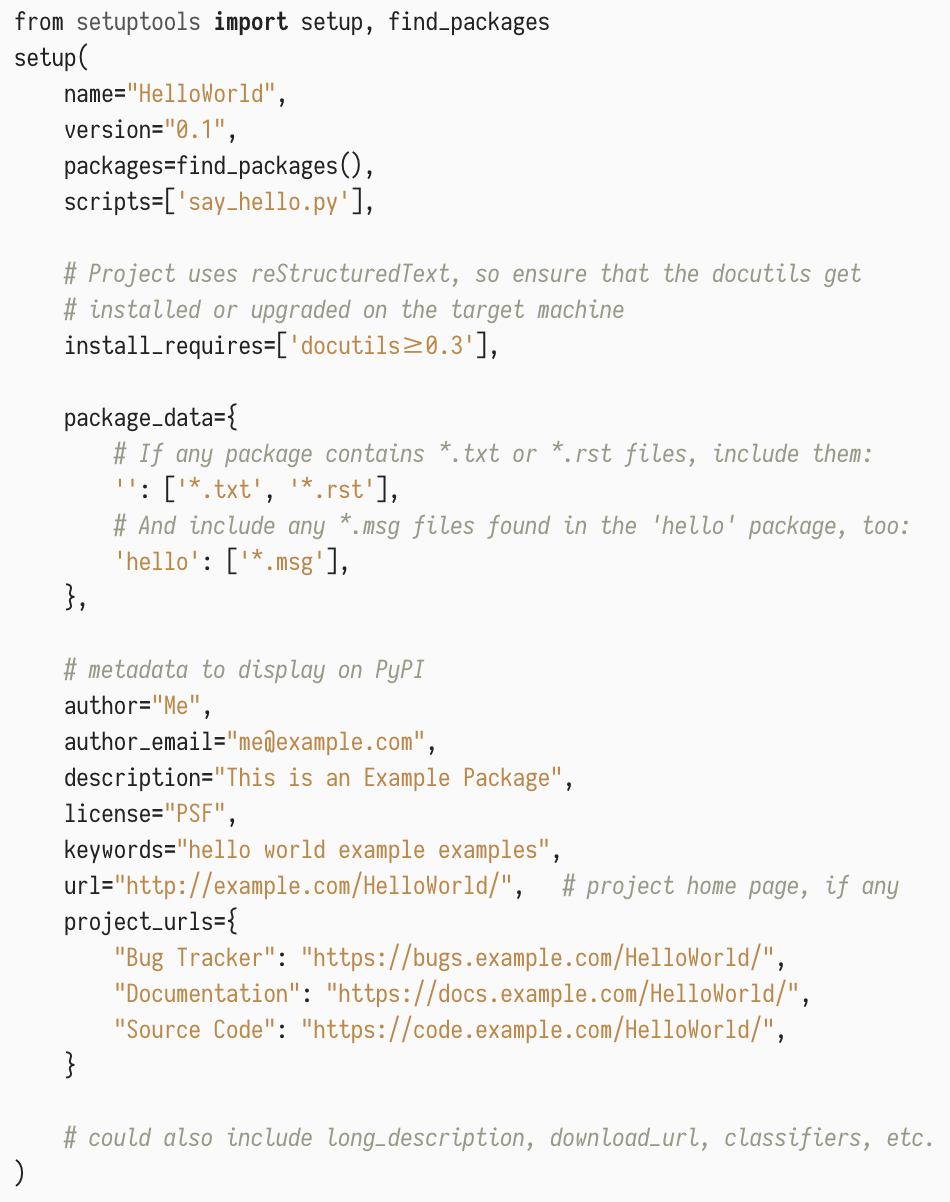
- Use standard Setuptools
- Messy documentation
- Need to write messy
setup.py
Modern Way 🤗
- Use Pipenv, Hatch, Flit, or Poetry
- Work as another
pip - Clean documentation
- Work as another
- I personally recommend Poetry
$ poetry init
$ poetry add chainer  # equivalent to `pip install chainer`
$ poetry build  # make wheels
$ poetry publish  # upload to PyPI
                  # pip installable after this command 🤗
Further Readings
- Type Annotation
- Data Classes
- Packaging and Dependency Management